
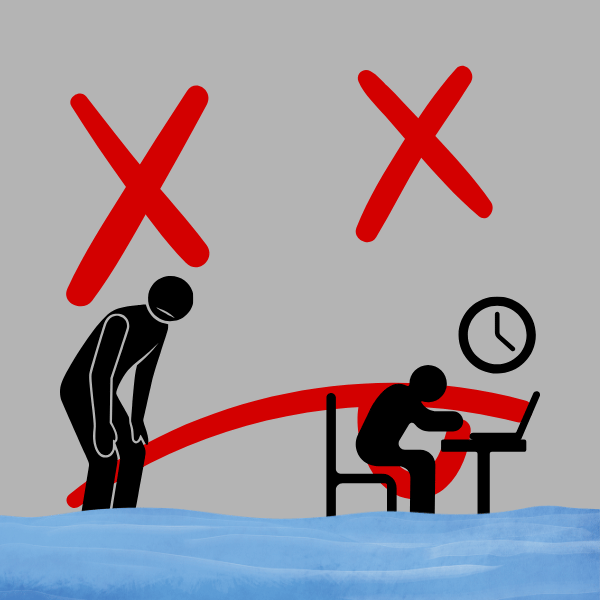
Some clients are just bad for you.
Not evil.
Not always even difficult in an obvious way. Just… bad for you.
The kind that leave you staring at your screen after a call wondering why you feel so drained.
The kind that make you question whether you’re actually good at this. The kind that, even after the project ends, you’re still carrying around in your head weeks later like an unpaid debt.
If you’ve been freelancing for any length of time, you know exactly the kind of client I’m talking about.
And if you’re in the middle of one right now, this is for you.
What a Bad Client Engagement Actually Does
It’s not just the project that suffers. It’s everything after it.
You finish the work.
You send the final file.
You tell yourself it’s over.
But the experience has already gotten into your head in ways that aren’t always obvious. You second-guess your next pitch.
You over-explain on your next brief.
You add qualifiers to your work that weren’t there before, little hedges and disclaimers that are really just leftover anxiety from the last engagement wearing professional clothing.
Or sometimes it’s simpler than that.
You just don’t feel like writing anymore.
The thing that used to feel purposeful now feels like something to get through. And you can’t quite put your finger on why, except that somewhere in the last few weeks a client made you feel like your work wasn’t good enough, your process wasn’t right, your judgment couldn’t be trusted.
That’s not a minor thing. That’s your confidence taking damage. And it needs to be treated like the real injury it is.
The types that do the most damage
Not all difficult clients are the same.
A demanding client who communicates clearly is exhausting but manageable.
The ones that genuinely wreck your motivation tend to fall into a few specific patterns.
The goalposts mover. Every time you deliver what was asked, the ask changes. You’re never quite meeting the brief because the brief keeps shifting. After enough cycles of this, you stop trusting your own ability to read a room.
The silent disapprover. Gives you very little feedback but makes it clear through tone, delays, and the general energy of every interaction that they’re not happy. You spend the whole project guessing what’s wrong and trying to fix something nobody will clearly define.
The one who makes it personal. Crosses the line from critiquing the work to implying something about you. Your professionalism, your intelligence, your commitment.
These are the ones that last longest because the wound isn’t professional, it’s personal.
How to Recover
First, let yourself be annoyed.
Don’t skip this step.
A lot of freelancers try to be too zen about bad engagements, processing them immediately into lessons and silver linings.
That’s fine eventually, but give yourself a day or two to just be frustrated. It was a bad experience. It’s okay to feel that.
Then, separate the client’s behavior from the quality of your work.
This is harder than it sounds but it’s the most important step. A difficult client is not an accurate critic.
Someone who moved the goalposts fifty times is not a reliable source of feedback on your abilities. Their dissatisfaction says more about them than it does about you, and you have to keep reminding yourself of that until it sticks.
Go back to work that felt good.
Pull up an old project you’re proud of.
Read the feedback from a client who valued what you did.
Recalibrate.
Your last engagement is not the full picture of your abilities.
Don’t let it define you.
Do a small piece of work just for yourself.
No client, no brief, no approval needed.
Write something because you want to.
This resets the relationship between you and the craft, reminding you that writing was yours before it was anyone else’s.
That’s the main reason why I ended up with six websites including this. Because of a bad client experience in the past, I decided that instead of writing for them for the rest of my life, why not start my own business and however slowly that might take me to reach success, I’ll keep doing it.
Here are my other sites:
Biyernes – I talk about cars, motorcycles and tech stuff here including kitchen appliances and prefab homes. Basically anything tech-related hat’s interesting to me.
ChipCanonigo – Well the name says it all, this is my personal blog. And I’ve kept this one up for decades. Yeah… I’m that old.
HayopETC – This started out as a t-shirt printing business that focused on animal themes. It evolved into a site that’s focused on providing knowledge about animals and pets.
MusikaWabad – Back in 2019, I wanted to write about local artists in Davao and shine a light on their talents. I’m fortunate to have kept this site up for a long time and it’s still going.
Jectra – This one’s the newest website of the bunch and at first I didn’t know what to focus on medically, now there’s a direction, emergency supplies and rescue equipment.
And of course this one, FilipinoWriters
And then, when you’re ready, take an honest look at what you’d do differently.
Was the brief unclear from the start and you didn’t push back?
Is there something in your process worth tightening?
Bad clients are tuition.
Expensive, demoralizing, occasionally infuriating tuition.
But you do learn something every time, even if it’s just a clearer picture of who you don’t want to work with again.
You will have more bad engagements.
Sounds pessimistic, I know but that’s just the nature of client work.
You can’t avoid them entirely.
But with time, you’ll get better at not letting them define what comes next.
One bad client doesn’t get to decide the rest of your career. Don’t give them that much space.